Journal
How to Hire an AI & Automation Consultant
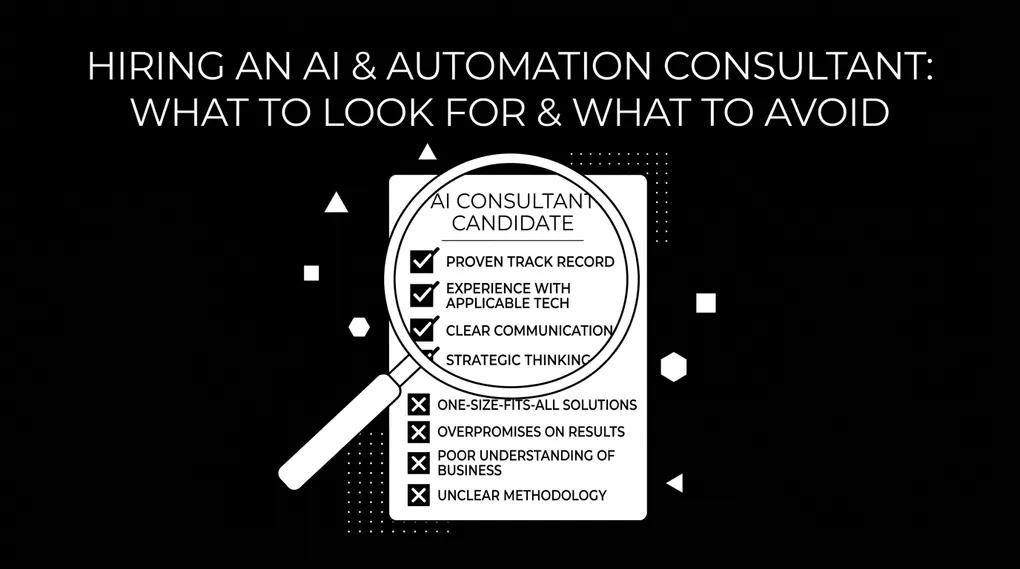
Every business owner eventually hits the same wall. You know AI and automation could help, but you don’t know who to hire, what to look for, or how to avoid wasting money on someone who talks a big game and delivers a mess.
I’ve been on both sides of this. I’ve hired consultants. I’ve been the consultant. Here’s everything I’d want to know if I were looking for an AI and automation integrator today.
How Do I Choose a Reliable AI and Automation Consultant?
Start with one question: do they understand your business before they recommend tools?
A reliable AI consultant begins with discovery. They ask about your workflows, your pain points, and where you’re losing time. They don’t walk in with a pre-packaged solution. They diagnose first, then prescribe.
Here’s what to check:
- Do they have a structured process? Look for a clear methodology: discovery, audit, design, build, support. If they can’t explain how they work, that’s a problem.
- Can they show real results? Case studies, client testimonials, before-and-after metrics. Not just “I built a chatbot.” What did that chatbot actually do for the business?
- Do they explain things in plain language? If a consultant can’t explain what they’re building without drowning you in jargon, they either don’t understand it themselves or they’re trying to make it sound more complicated than it is.
- Do they offer ongoing support? AI systems and automations need tuning. A good consultant doesn’t build and disappear. They monitor, adjust, and iterate as your business evolves.
At ConnectMyTech, we follow a five-step process: Discovery Call, Audit & Diagnosis, Solution Design, Build & Implement, Support & Iterate. Every project starts with understanding the problem before touching any tools.
What Should I Look for When Hiring an AI Integrator?
Beyond the basics, here’s what separates a real integrator from someone who watched a few YouTube tutorials:
Systems thinking over tool pushing. The best consultants design systems, not just implement tools. Anyone can connect Zapier to your CRM. The question is whether the workflow makes sense for how your team actually operates.
Cross-platform fluency. Your business probably uses 5 to 15 tools already. A good integrator knows how to connect them, not replace them all with something new. Look for experience across CRMs, automation platforms, AI tools, and data systems.
Change management awareness. This is the one most businesses miss. Implementing AI without preparing your team creates resistance, confusion, and what researchers call technostress. The technical build is only half the job. The other half is making sure people actually use the system.
Transparent communication. You should always know what’s being built, why, and what the expected outcome is. No black boxes. No “just trust me.” A good consultant keeps you in the loop at every stage.
How Much Does AI and Automation Consulting Cost?
This depends on three things: the complexity of your workflows, the number of tools involved, and how much custom building is needed.
Most AI and automation projects are either project-based (a defined scope with a fixed deliverable) or hourly consulting (ongoing advisory and troubleshooting). Some consultants offer monthly retainers for continuous support.
Rather than giving you a number that would be meaningless without understanding your business, I’ll tell you what to expect in terms of scope:
- An AI discoverability audit is a focused engagement. One to two weeks of assessment with a clear deliverable.
- A workflow automation build depends on how many processes you’re automating and how many tools are involved. Simple integrations take days. Complex multi-step systems take weeks.
- An AI agent deployment varies by how many tasks the agent handles, how much training data exists, and how deeply it integrates with your existing systems.
- Tech consultation is typically hourly. You bring the questions, the consultant brings the expertise.
The best way to get an accurate estimate is to have a discovery conversation. A good consultant will tell you the scope, the timeline, and the investment before you commit to anything. If someone quotes you without understanding your business first, that’s a red flag.
What’s the Difference Between an AI Integrator and a Freelance Developer?
This is the most common confusion I see.
A freelance developer or no-code builder is great at building things. They can wire up a Zapier automation, create a chatbot, or build a custom dashboard. They focus on the technical execution.
An AI integrator does that and more. They start with the business problem, not the tool. They understand your workflows, identify where automation actually creates value (not just where it’s technically possible), and design the system architecture before writing a single line of code or connecting a single integration.
The critical difference is the layer between business strategy and technical execution. A freelance developer builds what you tell them to build. An integrator tells you what should be built and why.
Here’s a real example. A client once asked me to “automate their email.” A developer would have set up an auto-responder. What they actually needed was a lead qualification system that routed inquiries based on service type, scheduled consultations for qualified leads, and sent follow-ups on a timed sequence. The “email automation” was actually a sales pipeline rebuild. An integrator identifies that. A developer builds what you ask for.
If your needs are simple and well-defined, a freelance developer is fine. If you’re trying to transform how your business operates, you need someone who thinks in systems.
DIY, an Agency, or a Fractional Integrator: Which Should You Choose?
Once you know what to look for, the next question is how to get the work done. There are three common paths, and they are not equal.
| What matters | Do it yourself (DIY) | Hire an agency | Fractional integrator |
|---|---|---|---|
| Who diagnoses the problem | You, with no framework | An account manager | One senior person who also builds it |
| Who builds the system | You or a freelancer | A team you rarely meet | The same person who designed it |
| Discovery before building | Usually skipped | Sometimes | Always |
| Ongoing support | You are on your own | Tickets and SLAs | A direct line to one person |
| Change management | Not considered | Rarely included | Built into the engagement |
| Cost model | Your time plus tools | Monthly retainer plus overhead | Project-scoped, no full-time salary |
A fractional integrator sits in the middle: more hands-on than an agency, more expert than doing it yourself, and far cheaper than a full-time hire. That is the model I work in.
Are There Red Flags When Hiring an AI Consultant?
Yes, and I see them constantly.
Red flag 1: They overpromise what AI can do. If someone tells you AI will “replace your team” or “10x your revenue in 30 days,” walk away. AI is powerful, but it’s a tool. It replaces repetitive, rule-based tasks. It surfaces information faster. It handles volume. It doesn’t replace human judgment, creativity, or relationship building. Anyone claiming otherwise either doesn’t understand AI or is selling you something.
Red flag 2: No ongoing support plan. AI systems and automations are not set-and-forget. Workflows break when tools update their APIs. AI agents need retraining as your business evolves. Data flows need monitoring. If a consultant builds your system and disappears with no support plan, you’ll be stuck the first time something breaks.
Red flag 3: Tool-first thinking. If the first thing a consultant does is recommend a specific tool before understanding your workflow, they’re selling that tool, not solving your problem. The right approach is always: understand the process, identify the bottleneck, design the system, then choose the tools. This is Systems Before Tools in practice.
Red flag 4: No discovery or audit phase. A consultant who jumps straight to building without diagnosing the actual problem is guessing. You wouldn’t want a doctor who prescribes before examining. Same principle.
Red flag 5: They can’t explain what they’re building. If you ask “what does this automation do?” and the answer is vague or overly technical, that’s a problem. You should understand exactly what’s being built and why.
How Do I Know if an AI Consultant Is Qualified?
There’s no single certification that makes someone qualified. The AI and automation space moves too fast for traditional credentialing to keep up. But here’s what to look for:
Portfolio and results. The strongest signal is demonstrated work. Case studies, client results, and live systems they’ve built. Ask to see examples. Ask to talk to past clients.
Platform experience. Look for hands-on experience with the tools relevant to your business. For automation, that might mean n8n, Zapier, Make, or GoHighLevel. For AI, that might mean Claude, OpenAI, or custom agent frameworks.
Relevant certifications where they exist. Some platforms do offer certifications. HubSpot Marketing, Claude Code from Anthropic, Google certifications. These aren’t sufficient on their own, but they show someone has invested in structured learning.
Academic or research background. This matters more than people think. A consultant with grounding in how people actually adopt technology, not just the technology itself, understands change management, not just implementation. My own research on AI adoption and technostress shapes how I approach every build.
Business acumen. The best AI consultants aren’t just technologists. They understand business operations, workflows, and what drives revenue. Technical skill without business context produces technically impressive systems that nobody uses.
Is It Better to Hire a Local AI Consultant or Work Remotely?
Both work. Here’s how to decide.
Remote-first is the default for most AI and automation work. The work is inherently digital. Screen sharing, video calls, and collaborative tools make it easy to audit workflows, design systems, and build automations from anywhere. Most of the projects I do at ConnectMyTech are remote, with clients across different cities and time zones.
Local has advantages for certain situations. If the project involves complex change management, in-person workshops with your team, or on-site system walkthroughs, being local helps. For businesses in Victoria, BC, I offer in-person discovery sessions and workshops when it adds value to the engagement.
The right question isn’t “local or remote.” It’s “does this consultant understand my industry and my problem?” Geography matters less than expertise. A remote consultant who has deep experience in your industry will outperform a local generalist every time.
At ConnectMyTech, we serve clients globally. Victoria and BC clients get the option for in-person sessions. Everyone else gets the same quality of work delivered remotely.
How Do I Find the Best AI and Automation Consultant for My Business?
There’s no universal “best.” There’s the best fit for your specific situation. Here’s how to narrow it down:
- Define the problem, not the solution. Don’t start by searching for “Zapier expert.” Start with “I need to stop manually routing leads.” The problem determines what kind of expertise you need.
- Look at their content. Does the consultant publish articles, case studies, or guides? Someone who writes about their work publicly is demonstrating their thinking. You can evaluate their approach before you ever talk to them.
- Check their process. Ask how they work. If they have a structured methodology (discovery → audit → design → build → support), that’s a good sign. If they say “it depends” to everything with no framework, keep looking.
- Start small. You don’t need to commit to a six-month retainer on day one. Start with a consultation or a small audit. See how they communicate, how they think, and whether their recommendations make sense before scaling up.
- Trust your gut on communication. The best consultant in the world is useless if they can’t explain things clearly or respond to your messages. Communication quality is a proxy for work quality.
How Do I Get the Best Value from an AI Consultant?
Value isn’t about getting the cheapest price. It’s about getting the right outcomes for your investment.
Come prepared. The more clearly you can describe your workflows, pain points, and goals, the faster the consultant can get to work. Document your current processes before the first call. List your tools. Write down where you lose the most time.
Ask about the system, not just the deliverable. Don’t just ask “can you build me a chatbot?” Ask “what system do I need to handle customer inquiries more efficiently?” The answer might involve a chatbot. It might involve something entirely different.
Prioritize ruthlessly. You probably have 10 things you want to automate. Pick the one that costs you the most time or money right now. Get that working. Then move to the next one. Trying to automate everything at once is a recipe for failure.
Invest in documentation and training. The cheapest project in the world is worthless if nobody knows how to use the system after the consultant leaves. Make sure the engagement includes documentation, training, and a support plan.
Measure outcomes, not hours. The value of automation isn’t measured in hours billed. It’s measured in hours saved, leads captured, errors eliminated, and revenue protected. Focus on the outcome, not the input.
Frequently Asked Questions
How do I choose a reliable AI and automation consultant? Look for a structured process (discovery, audit, design, build, support), real client results, plain-language communication, and ongoing support. A good consultant diagnoses before prescribing and designs systems before choosing tools.
What should I look for when hiring an AI integrator? Systems thinking over tool pushing, cross-platform fluency, change management awareness, and transparent communication. The best integrators understand your business operations, not just the technology.
How much does AI and automation consulting typically cost? It varies by scope. Projects range from focused audits (1-2 weeks) to full system builds (2-4 weeks or more). Most consultants work on project-based or hourly models. The best way to get an accurate estimate is a discovery conversation about your specific needs.
What’s the difference between an AI integrator and a freelance developer? A freelance developer builds what you tell them to build. An AI integrator identifies what should be built and why, starting with business strategy and designing the full system before choosing tools or writing code.
What are red flags when hiring an AI consultant? Overpromising AI capabilities, no ongoing support plan, recommending tools before understanding your workflow, skipping the discovery or audit phase, and inability to explain what they’re building in plain language.
How do I know if an AI consultant is qualified? Look for a strong portfolio with real results, platform experience relevant to your needs, relevant certifications (HubSpot, Claude Code, Google), academic or research background in the space, and demonstrated business understanding beyond just technical skills.
Is it better to hire a local AI consultant or work remotely? Most AI and automation work is done effectively remotely. Local matters for complex change management projects or in-person team workshops. The consultant’s expertise and industry experience matter more than their location.
How do I find the best AI consultant for my business? Define your problem first, look at the consultant’s published content and case studies, ask about their process and methodology, start with a small engagement, and evaluate their communication quality before committing to a larger project.
What questions should I ask before hiring an AI consultant? Ask about their process, see case studies from similar businesses, ask how they handle ongoing support, confirm they’ll diagnose before building, and ask them to explain a past project in simple terms. If they can’t do that last one, move on.
How do I get the best value from an AI consultant? Come prepared with documentation of your workflows and pain points, focus on the system rather than individual tools, prioritize one high-impact process at a time, invest in training and documentation, and measure outcomes rather than hours billed.
Ready to Talk?
If you’re evaluating AI and automation consultants, I’m happy to have a conversation. No pitch, no pressure. We’ll talk about your business, identify the biggest bottleneck, and I’ll tell you honestly whether I can help.