Journal
I Deployed OpenClaw for a Client. Here's What Matters.
What Is OpenClaw and Why Is Everyone Talking About It?
OpenClaw is an open-source AI agent framework that lets you self-host an AI assistant connected to your real tools and data. It has over 145,000 GitHub stars because it works. But after deploying it for a real client, I learned the agent is only half the story. The knowledge base is what makes it useful.
Over 145,000 GitHub stars. Baidu integrating it into their search app for 700 million users. Peter Steinberger just announced he is joining OpenAI. IBM, CNBC, and every tech outlet on the planet are calling it “the AI that actually does things.”
And they are right. It does. I know, because I just finished deploying it for a client.
But after spending weeks building out a full OpenClaw environment for a real business with real clients and real stakes, I walked away with one conviction that nobody in the hype cycle is talking about: the agent is only as powerful as the data behind it.
The knowledge base is the product. The agent is just the delivery mechanism.
What Does a Real OpenClaw Deployment Look Like?
A real deployment connects OpenClaw to the tools your business already uses. CRM, messaging, documentation, databases. For my client George, that meant wiring up GoHighLevel, GitHub, Supabase, and n8n so his AI assistant could access everything it needed to be genuinely useful across three businesses.
George runs three interconnected businesses: high-performance coaching, health optimization through blood testing and genetic analysis, and trading education. Three verticals. Dozens of active clients. A CRM full of pipeline data, conversations, and client histories. Content that needs to get produced. Leads that need follow-up. Morning briefings that need to happen whether George remembers to check his dashboard or not.
The goal was simple: give George an AI assistant he could message on Slack or Telegram like a co-worker, and have it actually understand his businesses well enough to be useful.
So we deployed OpenClaw on a Hostinger VPS, locked it down behind Tailscale, connected it to Claude via his existing Max subscription, and started integrating it with the tools he already uses. GoHighLevel for CRM, GitHub for documentation, Supabase for structured data, and n8n for the automation layer in between.
The deployment itself was smooth. OpenClaw’s architecture is well-designed for self-hosting. Docker container, environment variables, MCP server connections. If you are comfortable with a terminal, you can have it running in an afternoon.
But here is where it gets interesting.
Why Did the Agent Fail on Its Very First Message?
The agent failed because it had no data to work with. OpenClaw was deployed, connected, and running, but it knew nothing about the business, its clients, or its processes. This is the part every tutorial skips. A connected agent without structured business context is just an expensive chatbot with extra steps.
After everything was wired up, George messaged the agent: “Who are my active coaching clients?”
And it had no idea.
Not because OpenClaw failed. Not because Claude was not smart enough. But because we had not given it anything to work with. The agent was deployed, connected, running, and completely ignorant of the business it was supposed to serve.
This is the part that every OpenClaw tutorial skips. Every viral tweet about how someone’s agent negotiated a car discount or built a social network skips it too. They show you the output. They never show you the months of structured context that made that output possible.
How Do You Build a Knowledge Base for an AI Agent?
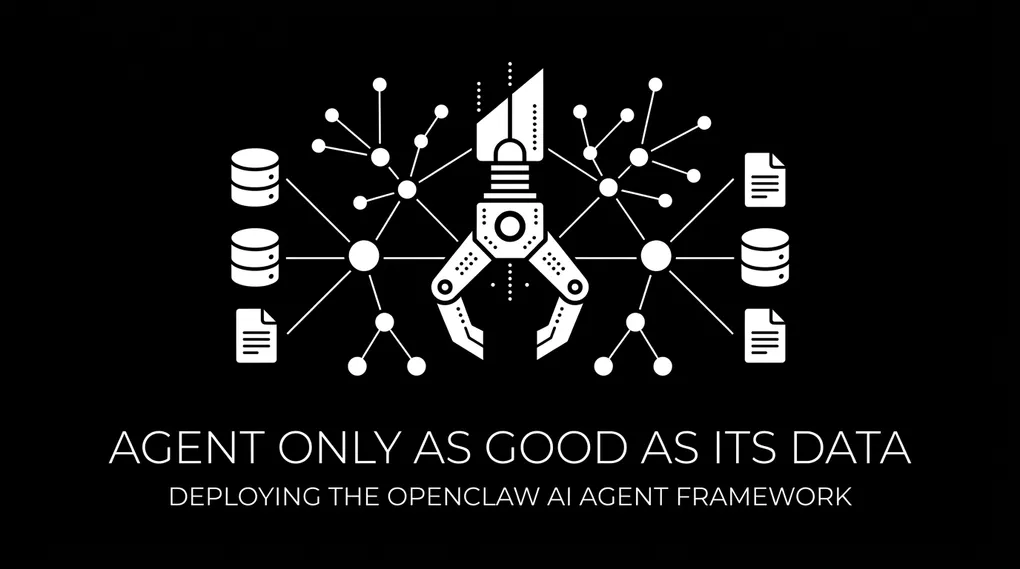
You build two layers. A “static brain” on GitHub with markdown files covering business identity, processes, and decision-making logic. And a “dynamic brain” on a queryable database like Supabase for live client data, pipeline status, and interaction history. Together, they give the agent both deep understanding and real-time awareness.
So we went back to fundamentals and built what I call the agent’s “brain.” It had nothing to do with prompt engineering or model selection.
The static brain lived on GitHub. We created a private repository and filled it with markdown files documenting everything about George’s businesses. Who he is as a professional. His coaching philosophy and methodology. The health optimization protocols he uses. His trading education framework. His brand voice and communication style. Decision-making principles. Pricing structures. Content frameworks.
This was not a quick dump of notes. This was deliberate, structured documentation designed so that an AI reading it would understand not just what the businesses do, but how George thinks about them.
The dynamic brain lived on Supabase. We built a schema with tables for clients, their health data, blood results, documents, interaction logs, and pipeline snapshots. GoHighLevel stayed as the CRM. George kept working the way he always did. But n8n sat between GHL and Supabase, syncing contacts, pipeline changes, and conversation data automatically via webhooks.
Now when George asked “Who are my active coaching clients?”, the agent queried Supabase and returned the answer in seconds. When he asked “Pull up John’s blood results,” it knew where to look. When a new lead came in from Instagram, it could add them to the right pipeline and ask if George wanted the welcome sequence triggered.
The agent had not changed. The model had not changed. What changed was the data underneath it.
Why Is the Knowledge Base More Important Than the Agent Itself?
Because everyone has access to the same models and frameworks. What makes your AI assistant different is the structured, business-specific data behind it. A well-organized knowledge base turns a generic chatbot into something that actually understands your business. The agent is only as powerful as the data you feed it.
This is what I need the OpenClaw community, and frankly anyone building with AI agents, to understand.
Right now, the conversation is dominated by which model is best, which agent framework is fastest, whether OpenClaw or Manus or Claude Cowork will win the agent wars. Peter Steinberger just got hired by OpenAI specifically because agents are “quickly becoming core” to their product roadmap.
But none of that addresses the actual bottleneck.
I have deployed automation systems for real estate agents, coaches, and small business operators. I have run workshops at RE/MAX offices. My research on AI adoption backs this up. And the pattern is always the same: the tool is never the problem. The data is.
An agent with access to Claude Opus and every MCP server on the planet is still useless if it does not know your clients, your processes, your brand voice, or your decision-making logic. A perfectly configured OpenClaw instance without a knowledge base is just a very expensive chatbot.
Meanwhile, a well-structured knowledge base can make even a basic setup extraordinarily powerful.
What Makes a Good Knowledge Base for Business AI?
A good knowledge base is structured, separated into static and dynamic layers, written for AI comprehension, and includes explicit decision-making logic. Structure matters more than volume. Five hundred words of clear process documentation beats ten thousand words of unorganized notes. And it needs to be treated as a living system, not a one-time setup.
After building several of these systems, here is what I have learned makes the difference.
Structure matters more than volume. A 500-word file that clearly explains your client intake process is worth more than 10,000 words of unorganized notes. The AI does not need everything. It needs the right things, organized so it can find them.
Separate static from dynamic. Business identity, brand voice, methodologies, product descriptions: these change slowly. Put them in version-controlled markdown files. Client data, pipeline status, interaction history: these change constantly. Put them in a queryable database. Do not mix them.
Write for the AI, not just for yourself. Most people write documentation assuming a human reader who already has context. Your AI agent has zero context beyond what you give it. Spell out acronyms. Explain relationships between concepts. State the obvious. If George’s coaching methodology has three phases, name them and explain what each one involves, even if George would never need that written down for himself.
Include decision-making logic. This is the one most people miss entirely. Do not just tell the agent what you do. Tell it how you decide. When should it escalate to George versus handling something on its own? What makes a lead “hot” versus “warm”? What tone should it use when a client has not responded in two weeks? These decision trees are what turn an agent from a lookup tool into a genuine assistant.
Treat it as a living system. The knowledge base is not a one-time setup. When George shares new information about a product launch, the agent should suggest adding it to the documentation. When a process changes, the outdated file should get flagged. The best AI assistants are the ones whose operators maintain the underlying data with the same discipline they would bring to any critical business system.
Is OpenClaw Worth the Hype?
Yes. A solo developer built an open-source agent that Baidu is deploying to 700 million users, that runs locally with full privacy, and that drew acquisition interest from OpenAI. The software is genuinely impressive. But the hype focuses on the tool and ignores the foundation. Deploying the agent is the easy part. Building the knowledge base is the hard part.
I do not want this to read as anti-OpenClaw. It is a genuinely impressive piece of software. The fact that a solo developer built an open-source agent that Baidu is rolling out to 700 million users, that drew acquisition interest from OpenAI, and that runs locally on your own hardware with full privacy: that is remarkable.
And the community building around it is exciting. Skills registries, MCP integrations, proactive cron jobs. The tooling is getting better every week.
But the tooling is the easy part. Setting up Docker, configuring environment variables, connecting messaging platforms: a technical person can do that in a day. Building the knowledge base that makes the agent actually useful for a specific business? That takes weeks of careful work, and it requires something no model or framework can automate: a deep understanding of the business itself.
This is Systems Before Tools in practice. The best deployment in the world is worthless without a foundation of well-organized, business-specific knowledge.
What Should You Do Before Deploying OpenClaw?
Spend 80% of your time on the knowledge base and 20% on the agent itself. Write out everything the agent needs to know as if you were onboarding a new employee who has never heard of your company. Separate what changes slowly from what changes fast. Define decision-making rules explicitly. Then connect the agent and watch it work.
If you are thinking about setting up OpenClaw, and you should because it is genuinely powerful, here is my honest advice:
Write out everything the agent would need to know to do its job. Treat it like onboarding someone who has never heard of your company. Build a data layer that separates what changes slowly from what changes fast. Define decision-making rules explicitly. Then set up the agent, connect it to those data sources, and watch it become something that actually transforms how you work.
The agent is the interface. The knowledge base is the intelligence.
And if the OpenClaw moment teaches us anything, it is that the world is ready for AI that actually does things. The question is whether we are willing to do the unglamorous work of giving it something meaningful to work with.