Journal
Systems Before Tools: Why Most Agents Fail at AI
Key Takeaways
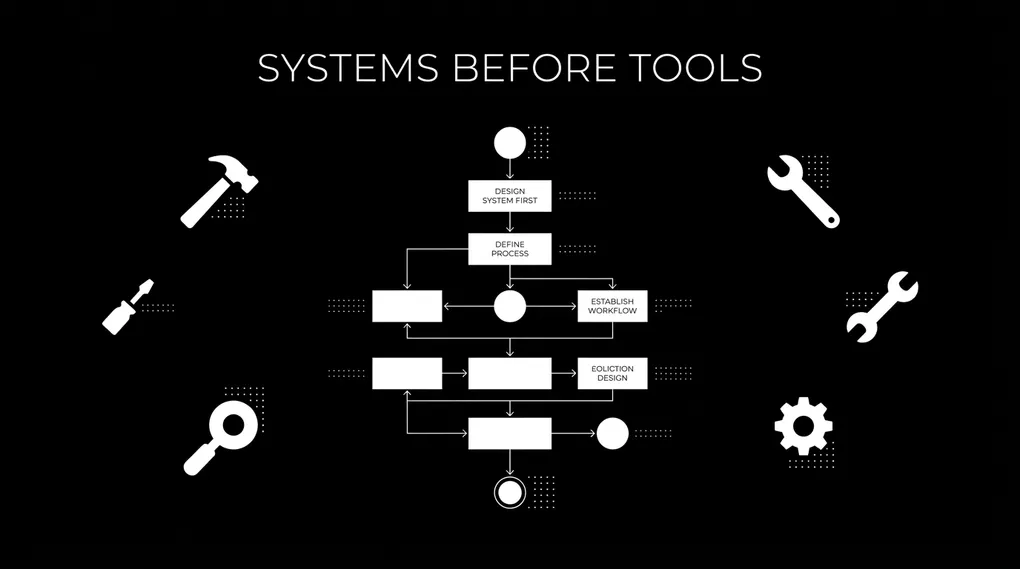
- Systems Before Tools is a five-step sequence: document the workflow, find where it breaks, design the ideal process, then pick the tool, then implement with support. The tool is the last decision, not the first.
- Tool abandonment is a systems problem, not a skill problem. Every agent I interviewed had a tool they pay for and never open. The missing piece was the system underneath, not their technical ability.
- Technostress is measurable. I measured five dimensions in my RE/MAX Camosun research, and techno-complexity was the strongest predictor of agents abandoning their tools.
- This is the rule I apply to every build — for clients, for ConnectMyTech, and for my own AI agents. Get the system right and the tool almost picks itself.
The Pattern I Keep Seeing
Every real estate agent I’ve interviewed in my research at RE/MAX Camosun has told me some version of the same story:
“I signed up for [tool]. Used it for two weeks. Now I’m paying for it but I don’t touch it.”
After 10+ semi-structured interviews and a 27-question survey, I’ve identified the root cause. It’s not that agents are bad at technology. It’s that they’re adopting tools without systems.
What Does “Systems Before Tools” Mean?
Most technology adoption follows this sequence:
- See a shiny new tool
- Sign up for a free trial
- Try to figure out where it fits
- Get frustrated when it doesn’t fit anywhere
- Abandon it
The sequence should be:
- Document your current workflow
- Identify where things break down
- Design the ideal process
- Select a tool that fits the designed process
- Implement with training and support
This is the “Systems Before Tools” framework. It sounds obvious. Almost nobody does it.
Side by side, the two sequences look like this:
| Tools-first (fails) | Systems-first (works) |
|---|---|
| See a shiny new tool | Document your current workflow |
| Sign up for a free trial | Identify where things break down |
| Try to figure out where it fits | Design the ideal process |
| Get frustrated when it doesn’t fit | Pick a tool that fits the designed process |
| Abandon it, keep paying for it | Implement with training and support |
Same five steps. Opposite order. One ends in a subscription you never open. The other ends in a habit that sticks.
What Does the Research Show?
My survey instrument measures five dimensions of technostress, adapted from Tarafdar et al.’s technostress framework (Journal of Management Information Systems, 2007). Here is each one, the survey statement that captures it, and what it tends to predict in the agents I studied:
| Dimension | How it shows up (survey statement) | What it predicts |
|---|---|---|
| Techno-overload | ”I am forced by technology to work much faster.” | Agents running 5+ tools without integration scored highest here. More disconnected tools, more overload. |
| Techno-complexity | ”I need a long time to understand and use new technologies.” | The strongest predictor of tool abandonment in my data. |
| Techno-insecurity | ”I feel threatened by coworkers with newer technology skills.” | Amplified in a commission-based environment, where every other agent is a competitor. |
| Techno-invasion | ”I feel my personal life is being invaded by technology.” | Hits harder for agents who already work irregular hours and answer phones at night. |
| Techno-uncertainty | ”There are always new developments in technology.” | Drives “wait and see” paralysis. The pace of AI change makes this worse than any tool wave before it. |
The takeaway from the table: the failure is rarely the agent. It is the load of running tools without a system to hold them together.
How Does the Framework Work in Practice?
When I designed the AI workshop series for RE/MAX agents, I structured it around the Systems Before Tools framework:
Session 1 was not about AI at all. It was about documenting existing workflows. Agents mapped out how they currently handle: lead intake, follow-up, listing preparation, market analysis, and client communication.
Session 2 was about identifying decision points and bottlenecks. Where in the workflow does a human judgment call add the most value? Where is a human just copying data from one place to another?
Session 3 - only then - introduced specific AI tools. And because agents already had documented workflows with identified bottlenecks, they could immediately see where each tool fit.
Session 4 was about building sustainable habits. Setting up the tool in their actual workflow, creating templates, and establishing a 2-week practice period with support.
A Worked Example: Lead Intake to Follow-Up
Let me run one real estate workflow through the whole sequence, the same one I used in the workshops. Take a single RE/MAX agent and the path from a new lead to the third follow-up. This is the workflow agents most often try to “fix” by buying a tool first, and it is where the tools-first approach fails hardest.
The tools-first version (what fails). The agent hears that a CRM with AI follow-up will save them. They sign up, import their contacts, and try to wire it into how they work. But nobody ever wrote down how they actually handle a lead. So the CRM sits beside their real process: a lead comes in by text, they reply from their phone, they mean to log it later, they forget. Two weeks in, the CRM is half-populated and contradicts their inbox. They stop opening it. The subscription keeps charging. This is techno-overload in action: one more disconnected tool, more load, no relief.
The systems-first version (what works). We run the same agent through the five steps before touching a single tool.
- Document the current workflow. We write it down exactly as it happens today: lead arrives (Zillow, sign call, or referral) → agent reads it on their phone → replies when they get a moment → tries to remember to follow up in a few days → sometimes does, often doesn’t.
- Identify where it breaks. The break is obvious once it’s on paper. The first reply is slow because it depends on the agent being free, and the follow-ups depend entirely on memory. Two failure points, both human, both predictable.
- Design the ideal process. New lead gets an instant acknowledgment so they aren’t ignored. The agent still writes the real first response with judgment, because that is where their value is. Follow-ups at day 2 and day 5 are scheduled, not remembered. The agent’s job shrinks to the judgment calls: qualifying the lead and deciding what to say.
- Pick a tool that fits the design. Now, and only now, the tool. An n8n flow or a GoHighLevel pipeline can send the instant acknowledgment and queue the day-2 and day-5 nudges. The tool slots into a process that already exists, so there is nothing to “figure out.”
- Implement with support. Set it up in their real pipeline, give them templates they can edit in their own voice, and run a two-week supported practice period so it becomes a habit instead of another abandoned login.
Before, the agent had a tool fighting their workflow. After, they have a system that handles the copying-data steps and hands back the steps that need a human. The tool didn’t change. The order did. That is the entire point.
How This Shows Up Across My Work
This isn’t a real estate idea. It’s the rule under everything I build.
- When I built a knowledge operating system chatbot, the work was structuring the knowledge first. The chat interface was the easy last step.
- The same logic runs my OpenClaw knowledge base: the agent is only as useful as the system feeding it.
- And it’s why I tell people that AI agent development for non-developers starts with mapping the process, not picking the model. I can’t code, and it doesn’t matter, because the hard part was never the tool.
The Core Lessons
- Technology adoption failure is usually a systems problem, not a technology problem.
- Technostress is measurable and addressable.
- Training without context is theater.
- The “Systems Before Tools” framework reduces adoption friction.
- AI is not the hard part. The hard part is getting humans to change how they work.