Journal
Why Your AI Tools Give You Generic Answers
The Same Story, Every Time
I talk to business owners in Victoria almost every week who tell me the same thing. They signed up for ChatGPT, or some AI add-on for their CRM, or an automation tool their colleague recommended. They tried it for a week. The results were so generic they stopped using it.
They assume the AI is not good enough yet. Or that their business is too niche for AI to help. Or that they need a more expensive plan.
None of those are the problem.
The Real Problem: Zero Context
Here is what actually happened. You opened ChatGPT and asked it to draft a follow-up email to a client. It wrote something that could apply to literally any business on the planet. No mention of your client’s name, their project, their history with you, their preferences. Nothing specific.
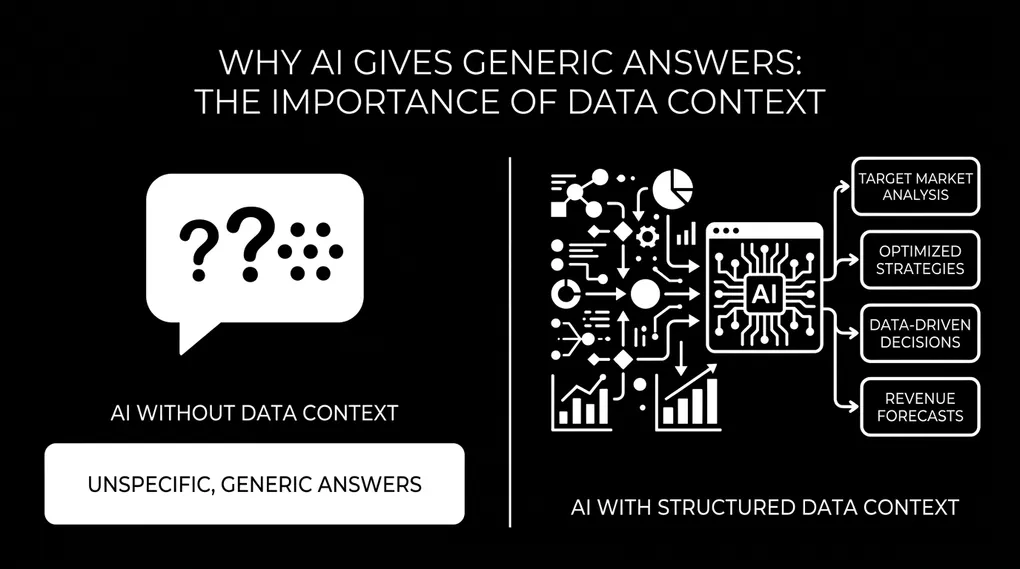
That is because ChatGPT has zero context about your business. It does not know your clients. It does not know your pricing. It does not know your processes. It does not have access to your CRM, your emails, your project notes, or your calendar.
You gave it a powerful tool with no data to work with. The result is always going to be generic.
The Data Gap Nobody Talks About
Most AI tools are marketed as if they work out of the box. Sign up, type a prompt, get magic. But that marketing glosses over a fundamental requirement: the AI needs your data to give you useful answers.
Without structured business data behind it, every AI tool operates in the same way. It draws from its general training data (the internet) and produces outputs that are plausible but not specific to you. It is like asking a stranger on the street to write a proposal for your client. They can write something grammatically correct, but it will not reflect your pricing, your relationship, or your service history.
The gap is not the AI’s capability. The gap is the data layer between the AI and your business.
What the Fix Actually Looks Like
The fix is not a better prompt. It is not a more expensive AI subscription. It is organizing your business data so AI can actually read it.
That means taking the information scattered across your CRM, email, Google Drive, spreadsheets, and your own memory, and structuring it into a knowledge base. Client records. Process documentation. Pricing history. Templates. FAQs. Market notes.
Once that structured data exists, the AI agent deployed on top of it produces fundamentally different outputs. Instead of a generic follow-up email, it drafts one that references the client’s last project, their budget range, and the specific service they asked about. Instead of a generic proposal, it pulls real numbers from your history.
The same AI technology. Completely different results. The only difference is organized data behind it.
How I Apply This in Victoria
I am an AI & Automation Integrator based in Victoria, BC. Every client engagement I take follows the same principle: organize the data first, deploy the tools second.
At RE/MAX Camosun, where I served as AI & Technology Integration Specialist, I saw this pattern with real estate agents constantly. The agents who have structured data in their CRM get useful AI outputs. The agents who have scattered, disorganized data get generic garbage and give up on the tool.
The research on AI adoption confirms this at scale. The biggest barrier to AI adoption is not technical complexity. It is technostress caused by tools that create more confusion than they save. And the root cause of that technostress is almost always unorganized data.
What You Can Do About It
If your AI tools are giving you generic answers, the problem is solvable. Start by asking yourself these questions:
Where does your client information actually live? Is it in one place or ten? If someone new joined your business tomorrow, could they find everything they need without asking you? If the answer is scattered and no, you have a data organization problem that no AI tool will solve on its own.
The path forward is to structure that data first, then deploy AI on top of it. That is exactly what I do for Victoria businesses through ConnectMyTech. I build the knowledge base, deploy the agent, connect the tools, and support you after launch.
If you want to see whether this approach makes sense for your business, book a free discovery call. I will tell you honestly whether it is the right fit.